What Is Encryption? How Scrambled Data Stays Private
Key points
- Encryption scrambles data with a key so only the matching key can restore it.
- Symmetric ciphers like AES-256 do the fast bulk work; public key math handles key exchange.
- HTTPS, messaging apps, device storage, and VPNs layer encryption against different observers.
- Modern ciphers have no known practical break; failures come from phishing, malware, and stolen keys.
On this page
Encryption is the quiet technology underneath almost everything you do online. It protects your card number when you buy something, your messages when you text, and your password when you log in. You use it hundreds of times a day without noticing.
At its heart, encryption is simple to describe. It takes readable data and scrambles it with a key so that the result looks like random noise. Anyone holding the right key can reverse the process. Anyone without it gets nothing useful, no matter how much of the scrambled data they capture.
This guide explains how that works in plain language: the two big families of encryption, where each shows up in your daily life, and what encryption honestly can and cannot protect.
The Lockbox Idea
Think of encryption as a lockbox. You put your message inside, lock it with a key, and send the box across the open internet. Couriers handle it, networks route it, strangers could copy it. None of that matters, because only someone with the matching key can open the box.
In real systems, the box is math. An encryption algorithm, called a cipher, transforms your data using the key. The scrambled result is called ciphertext. Feed the ciphertext and the correct key back through the cipher and the original comes out. Feed it the wrong key and you get noise.
One principle makes modern encryption trustworthy: the algorithms are public. AES, the world's most used cipher, is published and has been attacked by researchers for over twenty years. All the secrecy lives in the keys. A system that needs its method kept secret is a weak system, and serious cryptography stopped working that way long ago.
Symmetric Encryption: One Shared Key
Symmetric encryption uses the same key to lock and unlock. It is fast, even on a phone, which makes it the workhorse for bulk data. When a VPN encrypts your traffic or your laptop encrypts its disk, a symmetric cipher is doing the heavy lifting.
The names worth recognizing are AES-256-GCM, the long-standing standard used across banking and government, and ChaCha20-Poly1305, a newer design that runs especially fast on mobile processors. Cryptographers consider both strong. Modern versions of these ciphers also detect tampering, so a packet altered in transit fails its check and gets discarded.
Symmetric encryption has one famous problem. Both sides need the same key, and you cannot just send it across the network, because anyone listening would copy it. That puzzle is what the second family solves.
Public Key Encryption: The Clever Part
Asymmetric encryption, better known as public key encryption, uses a pair of mathematically linked keys. The public key can be shared with anyone, openly. The private key never leaves its owner. Data locked with the public key can only be unlocked with the private key.
This breaks the key-sharing deadlock. You can publish your public key to the whole world, and anyone can send you a message only you can read. Related math lets two parties who have never met compute a shared secret over an open network, with an eavesdropper watching every message and still learning nothing. That step is called a key exchange.
Public key math is slow, so systems use it sparingly. The standard pattern: use public key techniques in a brief handshake to agree on a symmetric key, then let the fast symmetric cipher carry the actual data. HTTPS works this way. So does your VPN, as our guide to how VPNs work shows step by step.
The Two Families Side by Side
| Feature | Symmetric | Public key (asymmetric) |
|---|---|---|
| Keys | One shared key | A public and private pair |
| Speed | Very fast | Much slower |
| Main job | Encrypting the actual data | Handshakes, key exchange, signatures |
| Famous examples | AES, ChaCha20 | RSA, elliptic curve methods |
| Hard problem | Sharing the key safely | Heavy math, so used briefly |
Where Encryption Protects You Every Day
- HTTPS encrypts your sessions with websites, the padlock in your address bar. It protects the content of each visit, though not everything around it, as our guide to whether HTTPS is enough explains.
- End-to-end messaging locks messages so only sender and recipient hold the keys. The service in the middle carries boxes it cannot open.
- Device encryption scrambles your phone's and laptop's storage, so a stolen device without its passcode is a brick full of noise.
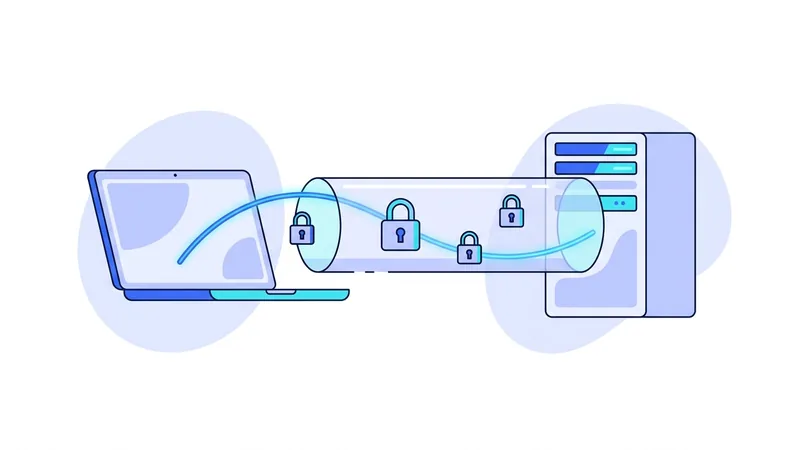
- A VPN wraps all of your device's traffic in one encrypted tunnel to a server, hiding your destinations from the local network and your provider. The specifics are in our VPN encryption explainer.
These layers overlap on purpose. A message can be end-to-end encrypted, inside an HTTPS connection, inside a VPN tunnel, on an encrypted disk. Each layer guards against a different observer, so the layers add up rather than cancel out.
What Encryption Cannot Do
Encryption protects data in transit and at rest. It does not protect data at the endpoints, and that is where things actually go wrong. If your device has malware, your data is readable before it gets encrypted. If you type your password into a convincing fake site, encryption faithfully protects the delivery of your password to a thief.
It also does not hide everything. An observer who cannot read your traffic can still often see that you connected, to which server, when, and how much data moved. Metadata sits outside the box, and protecting it takes other tools. Encryption also cannot vouch for who is on the other end by itself, which is why attackers focus on tricking you into encrypting to the wrong party. Our piece on man-in-the-middle attacks shows how that trick works and how systems defend against it.
Tip: when you evaluate any product's security claims, ask what is encrypted, between which two points, and who holds the keys. Those three answers tell you more than any marketing label ever will.
Can Encryption Be Broken?
The honest answer: not the modern ciphers, by any known practical method. Brute-forcing a 256-bit key is beyond any realistic computing power, by margins so large the numbers stop meaning anything. Researchers publish attacks that shave theoretical corners, and the industry retires algorithms long before attacks become practical. That is the system working.
Real-world failures happen around the encryption instead. Keys get stolen from servers. Software bugs leak data before it is encrypted. People get phished. When you read about a breach, the cipher is almost never the broken part. The lesson for daily life is to keep software updated and guard your keys and passwords, because you are protecting the endpoints, not the math.
If you want to see encryption working for you in practice, a VPN tunnel is the most visible everyday example, and the free vpn.now plan lets you run one and test it without spending anything.
Will Quantum Computers Break Encryption?
You may have read that quantum computers could one day break encryption. There is some truth to this, but it is calmer and slower-moving than the headlines suggest. A large, working quantum computer could in theory weaken some of the public-key encryption we rely on today, because it would be very fast at the kind of math that protects those keys. The important word is "could." Machines powerful enough to do this do not exist yet, and many experts think they may be years away.
So for everyday use, today's encryption is still strong. The lock on your bank login, your messages, and your traffic on vpn.now is not in danger from a quantum computer you can buy or rent right now. There is no such thing.
Even so, the industry is not waiting until the last minute. Researchers have built new "post-quantum" encryption methods, which are designed to stay safe even against a future quantum computer. Standards groups have started approving these methods, and software is slowly being updated to use them. Planning ahead like this is normal in security work.
One real reason to prepare early is a concern called "harvest now, decrypt later." The idea is simple:
- Someone records encrypted data today, even though they cannot read it.
- They store it and wait.
- If a quantum computer arrives later, they try to unlock it then.
This mostly matters for data that must stay private for many years. It is why forward-looking systems are starting to upgrade now rather than later. The honest takeaway is steady, not scary: today's encryption holds up for normal use, and the people who build these tools are getting ready ahead of time.
Summary
Encryption in a few lines:
- Encryption scrambles data with a key so only the matching key can restore it.
- Algorithms are public, keys are secret. That openness is a strength, not a weakness.
- Symmetric ciphers like AES-256 do the fast bulk work. Public key math handles handshakes and key exchange.
- HTTPS, messaging apps, device storage, and VPNs all layer encryption against different observers.
- The math holds. Failures come from endpoints: malware, phishing, stolen keys, weak passwords.
- Always ask what is encrypted, between which points, and who holds the keys.